
The shorter of the two figures in the middleground is Toni. The picture was taken on the Meseta between Castrojeriz and Itero de la Vega June 8, 2013
For more than a thousand years pilgrims have walked the Camino de Santiago, or Way of Saint James, to venerate the relics of the apostle in the city of Santiago de Compostella in Galicia, northwestern Spain. In fact there are many caminos, such as la via del plata from Seville or el camino portugués, but the most popular, and the one I intend to walk, is el camino francés from St. Jean Pied-de-Port on the French side of the Pyrenees, 490 miles from Santiago.
St. James the Greater, Santiago in Spanish, one of the 12 apostles, is supposed to have preached the gospel in Iberia before returning to Jerusalem, where he was beheaded by Herod Agrippa in 44 CE. According to legend his body was carried back to Galicia in a stone boat, without sailors, sails, oars or rudder, piloted by an angel.

When Umayyad Muslims conquered the Iberian peninsula starting in 711, the Celtic and Visigothic Christians took refuge in the mountains of northern Spain. In the mid ninth century St. James appeared on a white horse as Matamoros, slayer of Moors, led the Christians to victory at the mythical battle of Clavijo, and became the object of a cult which supported the reconquista, the reconquest of the Iberian peninsula between 842 and 1492.
Between the eleventh and fourteenth centuries Santiago became the most important pilgrimage destination. Christians could earn indulgences for walking to Jerusalem, Rome or Santiago, but Jerusalem was far off, and often in the hands of the Muslims, and Rome had a well-deserved reputation for corruption.
The Camino declined following the Black Death, Protestant Reformation and the decline of Spain itself, but there has been a resurgence of interest in the last three decades, with over 250,000 walking in 2010. For some it is a cultural experience, for others an athletic challenge. A minority of pilgrims earning the Compostela certificate of completion report that they do it for religious reasons. The majority do it for ‘spiritual reasons.’
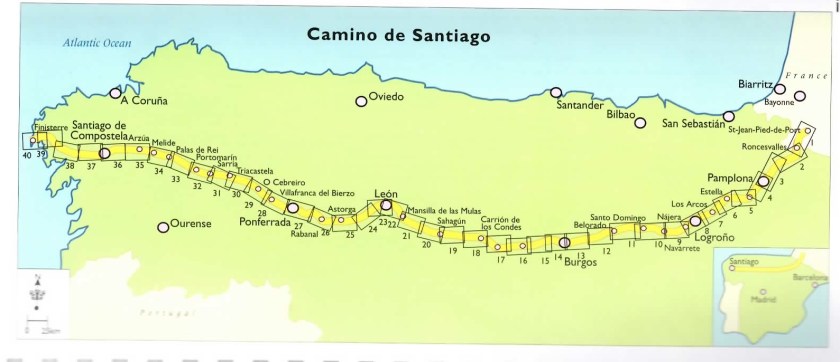
The Camino is typically divided into 33 stages, one day of walking for each year in the life of Christ. Cutie on the Camino, from whom I’ve stolen this map, gave herself 36 days to get to Santiago de Compostela, plus 4 more to get to Fisterra (or Finisterre, “the end of the world”). I am hoping to match that pace. After each day of walking, I plan to stay in an albergue or hostel and eat from the menu del peregrino.
 My Camino with Toni