Fisterra

We had reached Santiago, we had received our Compostelas, our certificates of completion. Our return flights were almost on the tarmac. Why continue to Fisterra?
Ninety-eight kilometers, four days walk beyond Santiago, it is becoming for many peregrinos, spiritual rather than religious, the end of the Camino.
Fisterra, Finisterre in Spanish, the end of the world, was the end of the Celtic camino before the Camino, the Via Lactea following the milky way, the pagan pilgrimage to the place the sun sets last, believed to be the westernmost place in the ancient world.
Possibly a thousand years older than the Camino, the Via Lactea is believed by some to follow a path of telluric energy, a tectonic fault line, known to the druids as a ley line or dragon line, a source of wisdom and connection with the stars.  In Fisterra was the Altar Soli where the Celts watched the sun die each evening, to be reborn the next morning. Nearby is the Pedra de San Guillerme, Saint William’s stone, where sterile couples used to copulate, following a Celtic rite of fertility.

The Camino follows in many places Roman roads likely built over Celtic trails. As in Mexico, Spanish churches were built in places already understood to be sacred by pagan predecessors, Aztec or Mayan, Roman or Celtic. The scallop shell of Saint James, whose salty contents recall womanhood, may have belonged once to Venus, and before that even, to Isis. The bullfight and the running of the bulls which now venerate San Fermin, may once have celebrated Mithra. It would not be the first time Catholicism appropriated paganism.

There is today a contemporary paganism associated with the Camino, with contemporary ritual. Peregrinos leave a stone at the Cruz de Ferro, build cairns along the way, and burn their clothing by the ocean after reaching Fisterra.
Sam and I went to scatter Toni’s ashes. The scattering of ashes belongs to the natural environment of Fisterra, not the man-made environment of Santiago. It belongs where She lives, not where He lives. It is pagan ritual, not Catholic. The medieval church believed in the resurrection of the body, requiring the preservation of the body. Indeed, cremation remained forbidden until 1963, and the scattering of ashes is still forbidden.
corbucion

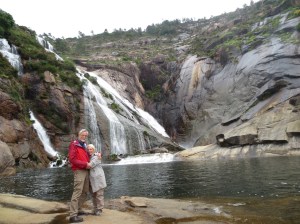
In 2013 Toni and I visited Fisterra, stopping to see a ria near the town of Corcubion. Una ria is where a river, un rio, enters the salt water. On the mountainous coast of Galicia, rias are dramatic, like fiords in Norway. The coast off Fisterra is la Costa da Morte, the coast of death, because of many shipwrecks on its treacherous rocks. It was near here that John Adams, blown off course, had to abandon his disabled ship and traverse the Camino in reverse on his way to the Paris talks which concluded the American Revolution.
wp-1474453393374.jpg

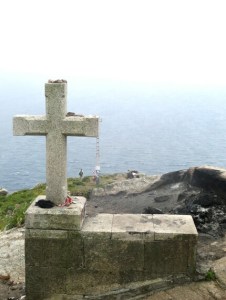
Sam and I took the bus to the town of Fisterra, then walked the last kilometer to the Cabo, the site of the lighthouse and a simple cross. More sure-footed than I, Sam took my hand and led me down the rocks close to the water. We sat for a few moments, looking westward at the Atlantic, then opened the pouch containing Toni’s ashes. It seemed we should say something, but I could find no eloquence. As Sam and I scattered the ashes into the wind, I could only think to say “Goodbye. Goodbye, Toni Jean Smith Wilson.” But even as I said it, I knew that was not right, not final, not complete.

Toni’s ashes were separated into thirds: one third to carry on the Camino, a second to scatter in the Caribbean off Mexico, and the largest third, to be mingled with my own ashes when the time will come. The second scattering I have yet to do. The third, the mingling, will be not done as long as I live, just as my goodbye cannot be said completely while I live. Toni is with me still.

Exploring my Bilateral Symmetry


When I applied for my credencial in St. Jean Pied-de-Port, I had to check whether the purpose for my Camino was religioso, espiritual, cultural or deportivo (sporting). I checked espiritual, though I might have checked any of the first three. But sporting? Fitness? That seemed bizarre to me. And so I embarked on a five hundred mile walk, thinking the walking itself was beside the point.

I have always lived in my head. Having a body was a necessary evil. More than once during a long stretch, I thought, “I am doing this, why? I don’t walk.”

As a graduate student in theater I took the required course in stage movement. Wearing leotards, we lay supine, responding to instructions to raise one knee, lower it, raise the other, lower it, breathe. Side coaching, sotto voce: “Attend to your proprioception. Explore your bilateral symmetry.”

Proprioception: At the time, I had to look it up. It is our inner awareness of our body in space, its position, its movement. It’s mysterious. Blindfolded, how do we know how we’re standing, how we’re moving? And, of course, it is the basis of our response to theater and dance and sports. We respond to the presence of the human body moving in space because we are bodies in space. The body in motion is the outward and visible sign of the movement of the soul toward the object of its desiring.

It was a basic course. We didn’t get to stand up and walk until the last week.

I’ve been exploring my bilateral symmetry quite a bit since I hurt my right foot, a little less than half-way through the Camino. The hurt never went away, but it was never the same as the day before.

Can I walk? Should I walk? Is the pain greater, or is it less? Is it gone? Is it back? What is it I’m feeling in my left foot? In my left thigh? In my right calf?

Is that pain? Is that pleasure? Are those different? Does it matter? It is sensation, it is aliveness. It is my body, and I am living in it, and I am living in the physical world. I am in my body. I am my body. I am alive!

So the thing is, strange, that final category, deportivo, whatever that means, living in my body, inhabiting space, being in this world, may be not that different from espiritual. On my next Camino, in 2017, maybe I will check ‘deportivo.’

Where Are They Now?

My daughter Sam is back in Brooklyn. She is preparing to perform with the puppet theater Great Small Works at La Mama ETC, for six decades New York City’s Mecca for experimental theater.

Levke from Germany, my first Camino friend, the young woman who was so kind to me and helped me from Biarritz to Bayonne to St. Jean and into my first albergue, finished in the town of Ages, just short of Burgos. She is now enjoying Oktoberfest in her home town of Munich. She is already talking about her next Camino.

Peter from Australia, my senior at 74, with two bandaged knees when I met him first on the climb from St. Jean to Roncevalles, reached Santiago several days before me, left before I could see him or hear his stories, and is now back home.

Elizabeth from Ireland, who had planned to celebrate her 73rd birthday in Santiago, was forced to leave the Camino after Viana in La Rioja because of temperatures in the upper 90s, several times reaching over 100 degrees. She told me that an English peregrino died from heatstroke, and others were hospitalized. Now she plans to resume her walk next year in time to reach Santiago for her 74th birthday.

Felicidad and Marilo, the twins from Bilbao, left the Camino as they had planned after Burgos, then went on to visit Prague. Next summer they will resume the Camino, starting where they left off.

Kristian from Denmark was last seen by Marianne in a hotel California hippie albergue community near Carrion de los Condes. She thinks he may never leave.

Danny from Nashville, who took care of me when I fell on my face, ‘blew out his knee’ coming down the steep hill after the Cruz de Ferro. After medical attention and two weeks rest, he still could not walk, so he has returned to the States. He intends to train over the winter, and return to finish the Camino in the spring.

Marianne from Canada had to leave the Camino after Leon to return to work. She says she is trying to apply to her life what she has learned from the Camino, but she hasn’t yet told me what that is.

Sam and I returned to Santiago from Fisterra late Monday afternoon. We decided to have supper outside the Hotel Gastronomico about an hour before the overnight bus to Madrid. Sam ordered prawn ravioli with a sea urchin sauce. I ordered a beer.

In a perfect Camino moment, a perfect Santiago reunion, Lena from Germany appeared in the hotel door! She had been in in Rabadiso, 40 kilometers east of Santiago, when she got food poisoning, and was taken to a hospital in Santiago for treatment. Even though she walked 750 out of the 790 kilometers, starting from St. Jean the same day I did, she will not get her Compostela because she has not walked all of the final 100 kilometers. She is not concerned: This is her second Camino, and she already has a Compostela.

For me, these friendships were the best part of the Camino.

After Toni’s death, I was overwhelmed to hear from so many of her students that she had changed their lives, that she had given them strength and confidence. Well, I was one of Toni’s students. When we met I was pathologically shy. I became a teacher because the only way I could face people was from behind a lectern. Over the course of forty years, Toni convinced me that I was not a failure, that I had value as a human being, that I could have friends. This Camino I owe to her.

Dear Friends

Dear friends of mine, and friends of Toni:

As I write this, Sam and I are safely back in Brooklyn and Buffalo, my right foot in a bucket of ice water.

I am deeply grateful to you for being with Sam and me on our journey. I have felt your presence. I have read and cried over your wonderful comments, even as I have not had energy or time to respond. This writing has been as necessary and as satisfying for me as the walking itself. I don’t understand my journey until I am able to share it in words or images, and for me that comes only slowly.

I’ve made a few observations I’ve not had time to blog about. And I’m not ready to process what should be the final post on Fisterra. So, asking your indulgence, I’ll make one or two more posts gleaning from the past six weeks before I wrap this up.

Santiago de Compostela

At 6:30 AM Sunday we are up and out of the albergue in Pedrouzo and walking the Camino by the light of a full moon. When the Camino enters the dark woods we follow the headlamps of the walkers ahead of us, now grateful that the way is crowded with peregrinos. By 7:15 we have reached a bar open for coffee, and the sun is rising.

The last stage is short, a little less than 20 kilometers, but we want time to explore the city and visit the cathedral, including the masterpieces of Master Mateo, whose work we first saw in Leon.

I have happily given over all responsibility to my daughter.  She reads the map and climbing charts.  She finds the yellow arrows marking the way.  She sets the pace. She decides when we can take a break, and when we must press on. She tells me today’s walk is all downhill.  She lies.

Facade of Cathedral at Santiago de Compostela

We reach the cathedral at 1:30. The structure is late romanesque, but the facade is the epitome of Spanish baroque, sumptuous, exuberant, glorious.

Our first stop is the Pilgrims Office. After waiting in a long line for well over an hour, we present our credencials, and are awarded our Compostelas.  Our pilgrimage is officially complete.

We are too late for the Pilgrim’s Mass, but in good time for celebration. The Praza is filled with newly arrived peregrinos, filled with happy reunions of walking companions, filled with expressions of exhaustion and relief. We greet Trevor from Seattle and Martine from France. We join Diana, English peregrina living in Germany, with whom we had walked a few days earlier, for a celebratory drink at the bar of the very fancy Parador dos Reis Catolicos.

The first two albergues we try no hay camas, have no beds, but further away from the centro historico we find one with space. We leave our backpacks there, and return to explore the cathedral and its attached museum.

From Master Mateo’s Choir

We have reached Santiago, but our journey is not finished: We still have Toni’s ashes to scatter. For that, we agree, we will travel by bus in the morning to Fisterra, the end of the world.

Galicia

Having walked across Navarre, La Rioja, Burgos, Palencia and Leon, I am now in Galicia, my destination.

Galicia is Spain’s Ireland. Before the reconquista, before the Muslims, before the Visigoths and the Suevi, before the Romans, Galicia was Celtic, and so it remains in many ways.  In O’Cebreiero round stone pallozas are thatched with straw. 

Queimada, from our trip, 2013

In Santiago in 2013 Toni and I drank a queimada, a flaming witch’s brew accompanied with a celtic incantation to ward off evil spirits.

Bagipes, from our trip, 2013

In Santiago, bagpipes celebrate civic occasions. The face of Martin Sheen (Galician, nee Estevez) is a map of Ireland.

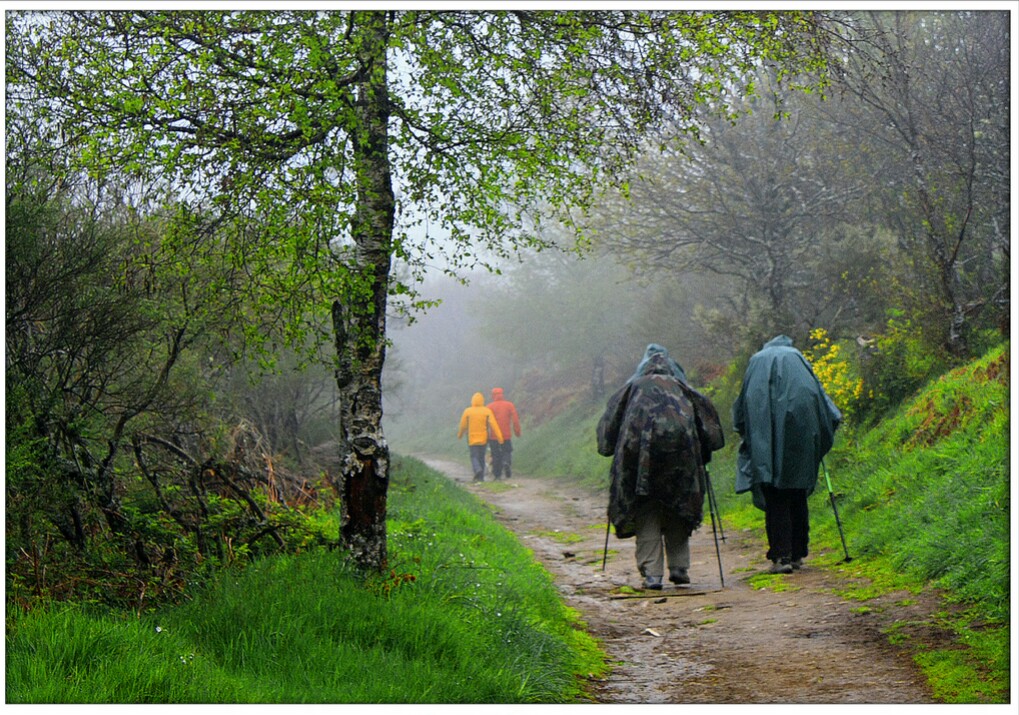
From Sarria until Rabidiso it has rained every day. So Galicia, like Ireland, is green, very green:

Not my image

Moss, lichens and ivy cover burly oak trees. Overhead, arching branches make romanesque barrel vaults. The earth is moist underfoot, the air redolent with cow dung. Mountain tops float like islands above the clouds.

The language is Gallego. It is a dialect of Spanish related to Portuguese, but to me it looks like Spanish put through a Buck Rogers decoder ring. The word for plaza, plaza in Spanish, is praza in Gallego.  Junta, committee in Spanish, becomes ‘xunta,’ government in Gallego. Church, iglesia in Spanish, comes out ‘igrexa,’ with an’r’ substituted for the ‘l’ and an all-purpose ‘x’ substituted for the ‘si.’

The Camino changes abruptly in Sarria, just over 100 kilometers from Santiago, the minimum to walk for a Compostela. Before, I could walk somtimes for hours without seeing another peregrino.  Now, there are always two or three dozen ahead or behind.  Before, the others were sharing a great adventure.  Now, they are competing for a limited number of albergue spaces.

Tomorrow, after almost six weeks of walking, I will walk with Sam into the great Praza in front of the Cathedral of Santiago. With good fortune, we will reach our destination hours before our scheduled return to our homes and our ‘real’ lives.  It is strange to worry about timetables and take-offs after so long moving ‘at the pace of living things.’

Samantha, Peregrina

I meet my daughter, Sam, at the bus station ln Leon.  She has already made her first Camino friend, Paula, a young Italian girl living in Belgium.  Paula has not yet obtained her credencial, so we go together to San Isidore where they are issued, then to the Albergue Santa Maria de Carbajal, where I can introduce Sam: Es mi hija!

First page of my credencial

Credencials are issued by various Catholic confraternities, and are required to stay at an albergue.  Sellos, or stamps, often beautifully designed, are added to the credencial at each albergue, and also at churches, museums and bars along the way.  When a peregrino reaches Santiago, the credencial is examined by a representative of the Church to determine whether the bearer is qualified to receive the Compostela, the certificate of completion of the Camino, written in Latin. A minimum of two sellos per day are required over the last one hundred kilometers, to verify that the pilgrimage has been undertaken on foot or by bicycle. The peregrino must also declare that the pilgrimage has been undertaken for religious or spiritual reasons. Those declaring athletic or cultural reasons receive a lesser certificate.
The next morning Sam and I visit Leon’s Cathedral, a 13th century wonder of stonework tracery and luminous stained glass in the French gothic style. We wonder at the fact that this cathedral was built in only 25 years, by a town that had at the time only 5,000 inhabitants.

As a result of my decision to backtrack and meet Sam in Leon rather than going forward to Sarria, we are now pressed for time to reach Santiago in time to catch our return flights out of Madrid on September 20. We must make good progress every day, and can afford no rest days. In order to resume where I left off in Rabanal, we take a bus to Astorga. We discover a bus to Rabanal runs just twice a week, on Tuesdays and Fridays at 1:30 in the afternoon, and it is Friday at 12:30. Once again, the Camino provides!

This western part of the province of Leon is called El Bierzo, and it has its own distinctive architecture of stone houses with log beams and overhanging balconies. On the outskirts of town the first floor is for livestock and the family lives on the second floor.


Albergue in Acebo

We stay at the albergue in Acebo and walk through the wonderful towns of Riego de Ambros and Molinaseca, which look much as they must have looked nearly a thousand years ago, when Christian peregrinos first walked the Camino.

In Ponferrada we stop at the 12th century Templar castle.  The Knights Templar were responsible for protecting the Camino in the 12th century until they became too rich and powerful, and were supressed by the pope.

Castle, Ponferrada

The scallop shell hanging on Sam’s backpack is the symbol of Saint James, worn by almost every Peregrino.  Toni gave it to me when we were in Santiago in 2013, and now I have given it to Sam.

In Cacabelos we have our first taste of pulpo, octopus cooked with garlic. It is rich, tender and sweet, a gustatory treat that does not travel well.  We will be watching for the next pulperia. We split a bottle of the local Mencia wine. The legend is that hundreds of years ago a French peregrino eating cabernet grapes spit out the seeds and brought viniculture to this mountainous country.

When we were young together, I would tease Toni with the saying, ‘happiness isn’t having what you want, it’s wanting what you have.’ In the end it was she who taught me by her capacity for appreciation, and that was part of what I loved in her.

I was a bit apprehensive about Sam joining me on the Camino. Walking seven or eight hours every day, today in a driving rain, is not for everybody. But Sam turns out to have the spirit of a peregrina. She chooses the hillier route over the easier one from Tricastela to Sarria. She wants to visit inside every church on the way.  She buys a second bottle of Mencia vino tinto for the group at the albergue. She is her mother’s daughter.
.

Why are you doing this Camino?

At the table in Villadangos, we are three Germans, two Singaporeans, one Russian, one Italian, one Dutch, one Brazillian, and myself. On other evenings I have met many Danes, Belgians and Australians, some Irish, Poles, Canadians and Koreans, and a few Americans. Officially, the greatest number of peregrinos come from Spain, followed by France, but I’ve had less conversation with them.

English is the lingua franca.  Only the French appear unable or perhaps unwilling to use the shared language.

Conversation always begins with “Where are you from,” followed by “Where did you begin your Camino?” “Where do you go today?””How are your feet?” However rudimentary the question and answer, the content seems the same: the expression of good will and camaraderie in a shared adventure. Friendships form with amazing rapidity. Albergue entrances are the scene of much hugging and happy reunions of Camino friends who were strangers only days ago.

In 1987 the European Community adopted the Camino as its first cultural route, in recognition of its unifying smbolism.  The icon, seen above as a way marker, represents both the scallop shell of Saint James and also the convergence of many paths to a single destination, the many roads to Santiago.  The symbolism served a Europe in need of unification, much as ‘E Pluribus Unum’ served our fledgling union.

Another question, “Why are you doing this Camino,” seems to differentiate southern Europeans from the rest of us.  The Spanish, in particular, act as if walking across their country is the most natural thing to do, just good exercise in the fresh air. The three young Spaniards at the table in St. Jean said, “I just got a job,” “I just got a promotion,” and “I just lost my job and need a new one.” In fact, any reason seems reason enough for the Spanish.

The significance attached to the act of pilgrimage seems proportional to the distance the pilgrim has come.  “I turned 60 in June, and I had to prove to myself that I still could do it,” Thomas from Denmark told me. “I’m homeless no more, and I have to give to God thanks,” Helge from Germany said.  “After I retired, I became invisible. I felt I was no longer a man,” Michael from South Africa confided in me, within an hour of our meeting. “I need to find something again, I don’t know what it is, inside myself.”

It seemed to me very strange, at first, to confide in strangers the reason for my Camino. “My wife died,” is not an easy thing to say, or an easy thing to hear. But in the spirit of sharing that is the Camino, it would seem even stranger not to say it. In return for that sharing, I have received simple acknowledgement, unexaggerated sympathy, and yes, actually, a bit of healing.

Missing Toni, awaiting Sam, back to Leon


I have walked days of 29, 27 and 30 kilometers, taking me past the meseta, so I have little doubt now that I will complete my Camino. In another day I can remove the butterfly closures.  I will be glad not to have to explain to people how I fell on my face. My foot still hurts, but evidently less than others’. At night the albergue looks like a hospital ward, peregrinos barely ambulatory, icing feet and ankles, wrapping knees, tending to blisters. But at 5:30 the next morning these same cripples set out to walk another 30 kilometers.

Since Burgos, Leon, and, last night, Astorga, I am increasingly travelling parts of the Camino that Toni and I visited in 2013. I miss Toni every day, but most vividly when I revisit those sights we enjoyed together.

10426560673_0fcd056b68_z-1.jpg
San Isidoro, Leon
Toni at the Palacio Episcopal, Antonio Gaudi, Astorga, 2013

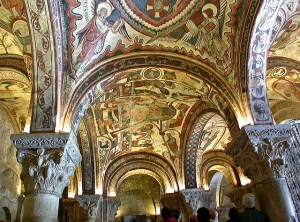
Leon is famed for its 13th century cathedral, with delicate French stonework and filled with light through stained glass.  But for me the highlight is the 11th century San Isidoro. We think of Romanesque churches, like Greek statuary, as abstract, bare stone. Both were originally painted in bright colors.  Almost nowhere has as much of the paint survived as it has here, the Sistine chapel of the Romanesque.

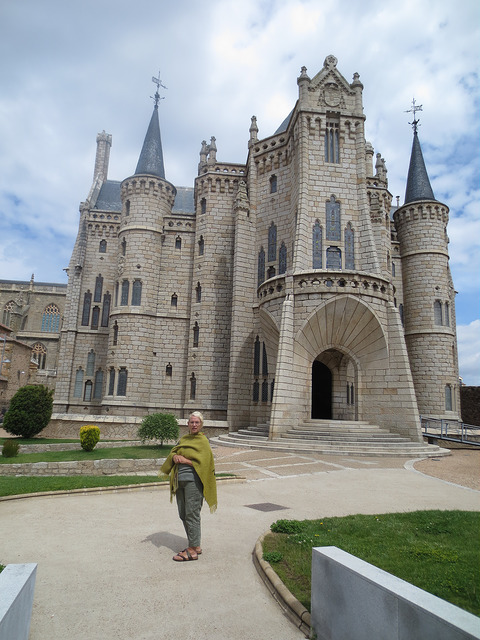
Antoni Gaudi, famed for his modernist work in Barcelona, began his career in Leon and Astorga.  Toni was particularly delighted with his Palacio Episcopal in Astorga. Not yet his mature work, the Palacio is nonetheless a delightful fantasy on medieval themes, the same spirit that takes free flight in the Sagrada Familia. Note the whimsical entrance in the shape of a bishop’s mitre.

Toni also delighted in the liveliness of the Mexican Zocalo, the Spanish Plaza Mayor, dining al fresco, tables full of chatter and conviviality. Tonight I will dine alone in Astorga’s Plaza de Espana.

However, our daughter, Sam, is flying to Spain to join me for the last part of the Camino!

This has been long planned, but I have lost track of time and been confused about the date, so now I will backtrack, by bus, to Leon to await her arrival.

Next Steps, Fromista

I am given an appointment for a follow up visit at the consultario at 6 pm the following evening.  This means I will lose two days from my Camino. I treat myself to a hotel room with a bathtub.  I take a bath in the morning, a second bath in the afternoon.

My enforced stay in Fromista gives me the opportunity to spend several hours revisiting the wonderful Romanesque church of San Martin. Toni and I visited it in 2013, and the photos below are from that visit.

Exterior, San Martin

San Martin is not, actually, a sacred space.  Deconsecrated and very thoroughly restored, it is more a museum piece than a church.  But what a jewel of architectural history it is! I think it is the most perfect early Romanesque church I have ever seen.

Begun in 1066 and built over about 20 years, it is both a summation of 11th century Romanesque, and an anticipation of things to come. Beginning with an octagonal plan, reflected in its cupola, it is elongated, anticipating the cross shaped plans of late Romanesque and Gothic churches. The twin towers (one showing in photograph above) suggest a German influence, as in the cathedral at Trier.

The capitals and corbels are dramatic and playful in a way which anticipates, for me, the work of Gislebertus at Autun a centuty later.  Below, the Adam and Eve.

Adam and Eve, San Martin
Corbels, San Martin

I hear from Lena that she is one town ahead, in Carrion de los Condes, so I join her there at the end of the day. She has her own tale of woe.  She has fallen victim to the dreaded chinchas, the bedbugs that infest albergues along the Camino. I can see the charcteristic groupings of bites in threes. When she confronts the hospitalero, he accuses her of bringing the infestation, and throws her out of the albergue.  Too late to enter another albergue, she spends the night outside and alone, terrorized by a drunken man. She is afraid that the bedbugs are infesting her clothing, and will be impossible to get rid of.  Her story trumps mine.

I am confident that my facial wounds will heal, but less confident about my bruised heel. We both wonder if we will continue our Caminos.

Next morning, our next steps seem clear.  Lena will take the bus ahead to join Marianne, who has already reached Leon.  I will resume walking, short stages to start, testing my heel as I go. Left foot, right foot.