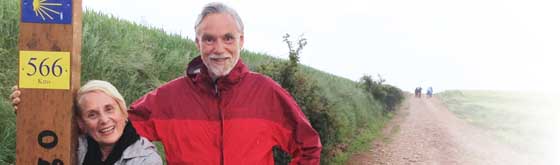
Fantasies, West of Pamplona

Toni was the perfect travelling companion.  Often when we traveled with Americans, they would complain their room was too small, or towels were missing, or reservations lost.  Toni was just delighted to be seeing new places, learning new things, eating new food.  I loved her zest for travel. We shared a fantasy about living in exotic places, especially in medieval Centro Historicos with ancient stone houses fronting on narrow streets, windows with flower boxes.  How was it possible for people to live amidst such beauty? At home in Buffalo, we watched House Hunters International. When they featured Spain or Italy, we’d wonder, could we trade our house straight up for one of those?

Puente la Reina

So Toni would have been out of her mind to have seen Se Vende signs in these Spanish Basque towns west of Pamplona: Uterga, Muruzabel, Obanos and Puente la Reina.  Right now we’d have been trying to figure out how to make it happen.

August 10th: Roncevalles — I thought I was going to die.

I thought a mountain pass was a low valley between two mountain peaks. Not all that low, actually.  I considered stopping and staying at the first albergue at Orrison, but a couple of teenaged girls sprinted past me, and turned to say “Hey senor, esta bien?” Their kindness pissed me off so much that I resolved to make it all the way to Roncevalles. This so-called mountain pass climbs to 1400 meters, about 4600 feet, then drops steeply to 900 meters. It is a place of cattle, sheep, horses, oak and beech trees, and transcendent beauty.

I dragged my sorry body into Roncevalles at 7 PM, after 12 hours of walking, and saw 60 steps leading up to the albergue door, a cruel joke.

Three middle aged Irish ladies I’d met in St. Jean were there, already changed into their cocktail dresses. They told me that they had arrived at 1 PM, and were planning to stay in Pamplona the next night, about 50 kilometers down the Camino.   My goal was to reach Pamplona on Friday. Can I  walk to Santiago?  I don’t know. 

I was lucky to get a bed in a room with forty beds.  I had brought the recommended earplugs, but I didn’t need them.

August 9 St. Jean Pied-de-Port

saint-jean-pied-de-port-pays-basque1_md

I am finally here, ready to begin my pilgrimage.  When I arrived in Madrid I  realized that I had no idea how to get from Biarritz to St. Jean.  I spotted a young German woman with a backpack, surmised she was on her way to do a Camino, and asked if she knew the way from Biarritz to St. Jean.  My first Camino friend, Levke from Germany, was so solicitous of an obviously helpless old man that she took me to the bus to Bayonne, then the train to St. Jean, then found me an albergue for the night.

Jean Pied-de-Port, the ‘foot of the gateway’ or mountain pass across the Pyrenees between the French Pays Basque and the Spanish País Vasco or Navarre, is the meeting point of the Chemin de St. Jacques trails from Paris, Vezelay, Le Puy and Arles.   My destination for tomorrow, and the first town on the Spanish side, is Roncevalles, about 25 kilometers away.

This pass was the site of the 8th century battle which inspired the 11th century Chanson de Roland, and through it, the 14th century cult of chivalry.

In this age when many want to ‘make America great again,’ in is interesting to be reminded that in what Barbara Tuchman called ‘The Calamitous Fourteenth Century,’ the cult of chivalry had no basis in reality, and only a basis in nostalgia for a past that had never been.

Charlemagne’s rear-guard was ambushed in this mountain pass in 778 CE, providing the basis for the Song of Roland, the beginning of French literature, and the beginning of the myth of chivalry.  Never mind that the attack was in retaliation for Charlemagne’s destruction of the walls of Pamplona, not a holy war, never mind that the attackers were Basque and not Muslim.  Never mind that Roland and his rear guard were routed ignominiously. The Song of Roland is a classic example of strategic revisionism.

About this Blog

The weary, unshaven pilgrim stumbles in to a tiny medieval village on the Camino and searches desperately for . .  . a WiFi connection to update his blog.  300,000 peregrinos may complete the Camino this year, and apparently most of them will write a blog, self-publish an eBook or upload a youTube video, explaining how they were going through a life transition and why the Camino was for them a life-changing experience.

Well, I’m going through a transition, and I could use a little life-changing just now.

Let us prepare to grapple with the ineffable itself, and see if we may not eff it after all. –Douglas Adams

I have read or watched a bunch of Camino blogs, eBooks and youTube videos, and I’m not much closer to effing the ineffable, but I do know that I only know what I feel when I try to put it into words or images. A few of my friends have expressed interest in following my journey, and that has given me sufficient excuse for this project.  Since I am carrying only a phone, and my thumbs are very large, my posts will likely be sporadic and mercifully brief.  You may follow this blog by entering your email address and clicking “follow” at the top of this page if you are using a computer, or at the bottom if you are using a phone.

Why the Camino Enchants Me

My enchantment with the Camino dates to 1969 when Sir Kenneth Clark did an episode of his Civilisation series featuring the 12th century pilgrimage churches at Vezelay and Autun, southeast of Paris.

Vezelay
Abbey Ste. Marie-Madeleine at Vezelay

Thirty years later Toni and I visited those two romanesque churches, as well as St. Trophime in Arles. In each of these numinous spaces, the presence of the sacred touched me.

In Sister Jean’s medieval art history course at Daemen I learned these churches were each starting points for the Camino de Santiago, which at its height in the 12th century, drew a million pilgrims each year.


Igrexa_de_Santiago2
Igrexa de Santiago in Barbadelo


In Spain, in 2013, I felt that presence again, vividly, in San Martin in Fromista, San Isodoro in León and Santa Maria Real in O’Cebreiro.  And, surprising to this city boy, I felt it also in the plains of the meseta and the mountains of Galicia.

Toni, of course, loved little bars in the ancient villages with tapas and 1 € glasses of vino tinto. Despite her complicated history with the Catholic church, I remember how deeply moved she was by the Igrexa de Santiago in Barbadelo.

As a fallen-away Unitarian, I don’t know much about God, but I do know where He lives.

Caminando Con Toni

cover2

Toni and I visited the Camino de Santiago in 2013 with Road Scholar.  The following summer we were making plans to walk the whole Camino together when we learned that Toni’s cancer had returned, and spread to her liver.  She died May 28, 2016.  Now I am walking the Camino.

Toni is with me.

Toni is not with me. Profoundly, palpably, not with me.

I am carrying her ashes.  She is with me.


Like most blogs, this is in reverse chronological order, most recent entries first.  To read the blog from the beginning, I recommend you click here.