We had reached Santiago, we had received our Compostelas, our certificates of completion. Our return flights were almost on the tarmac. Why continue to Fisterra?
Ninety-eight kilometers, four days walk beyond Santiago, it is becoming for many peregrinos, spiritual rather than religious, the end of the Camino.
Fisterra, Finisterre in Spanish, the end of the world, was the end of the Celtic camino before the Camino, the Via Lactea following the milky way, the pagan pilgrimage to the place the sun sets last, believed to be the westernmost place in the ancient world.
Possibly a thousand years older than the Camino, the Via Lactea is believed by some to follow a path of telluric energy, a tectonic fault line, known to the druids as a ley line or dragon line, a source of wisdom and connection with the stars. In Fisterra was the Altar Soli where the Celts watched the sun die each evening, to be reborn the next morning. Nearby is the Pedra de San Guillerme, Saint William’s stone, where sterile couples used to copulate, following a Celtic rite of fertility.
The Camino follows in many places Roman roads likely built over Celtic trails. As in Mexico, Spanish churches were built in places already understood to be sacred by pagan predecessors, Aztec or Mayan, Roman or Celtic. The scallop shell of Saint James, whose salty contents recall womanhood, may have belonged once to Venus, and before that even, to Isis. The bullfight and the running of the bulls which now venerate San Fermin, may once have celebrated Mithra. It would not be the first time Catholicism appropriated paganism.
There is today a contemporary paganism associated with the Camino, with contemporary ritual. Peregrinos leave a stone at the Cruz de Ferro, build cairns along the way, and burn their clothing by the ocean after reaching Fisterra.
Sam and I went to scatter Toni’s ashes. The scattering of ashes belongs to the natural environment of Fisterra, not the man-made environment of Santiago. It belongs where She lives, not where He lives. It is pagan ritual, not Catholic. The medieval church believed in the resurrection of the body, requiring the preservation of the body. Indeed, cremation remained forbidden until 1963, and the scattering of ashes is still forbidden.
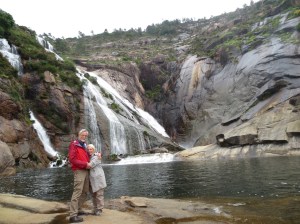
In 2013 Toni and I visited Fisterra, stopping to see a ria near the town of Corcubion. Una ria is where a river, un rio, enters the salt water. On the mountainous coast of Galicia, rias are dramatic, like fiords in Norway. The coast off Fisterra is la Costa da Morte, the coast of death, because of many shipwrecks on its treacherous rocks. It was near here that John Adams, blown off course, had to abandon his disabled ship and traverse the Camino in reverse on his way to the Paris talks which concluded the American Revolution.
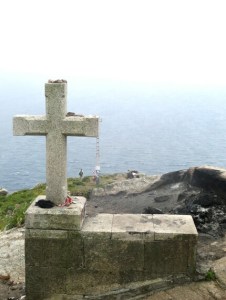
Sam and I took the bus to the town of Fisterra, then walked the last kilometer to the Cabo, the site of the lighthouse and a simple cross. More sure-footed than I, Sam took my hand and led me down the rocks close to the water. We sat for a few moments, looking westward at the Atlantic, then opened the pouch containing Toni’s ashes. It seemed we should say something, but I could find no eloquence. As Sam and I scattered the ashes into the wind, I could only think to say “Goodbye. Goodbye, Toni Jean Smith Wilson.” But even as I said it, I knew that was not right, not final, not complete.
Toni’s ashes were separated into thirds: one third to carry on the Camino, a second to scatter in the Caribbean off Mexico, and the largest third, to be mingled with my own ashes when the time will come. The second scattering I have yet to do. The third, the mingling, will be not done as long as I live, just as my goodbye cannot be said completely while I live. Toni is with me still.
 My Camino with Toni
The most beautiful. Thank you for taking me along . I also will not say good bye yet. Love you….
LikeLike
Beautiful…
LikeLike
and still with all of us who loved her, I hope, but especially with you and Sam. No one truly dies who is remembered.
LikeLike
A person’s ashes are symbolic for those who loved the deceased,
but the spirit of the loved one touches all who knew them.
LikeLike
😦 beautiful.
LikeLike
It’s a lovely thought to imagine Toni swirling around the cold, dark Atlantic waters skipping between Europe and North America. And then bouncing around the warm, turquoise Caribbean kissing the beaches and tickling the toes of laughing children. And someday – long into the future, we all hope, Chris- snuggling with you as you both fly off on the wind together. This journey has been meaningful for all of us. Thank you for sharing.
LikeLike
Chris – if this is the final Camino post, it is a post worthy of the journey. And your journey touched me more deeply than I could have anticipated because it taught me the full meaning of “partner for life.” Toni is smiling.
LikeLike
Thank you for so selflessly and beautifully sharing your journey. So grateful for your and Toni’s friendship.
LikeLike